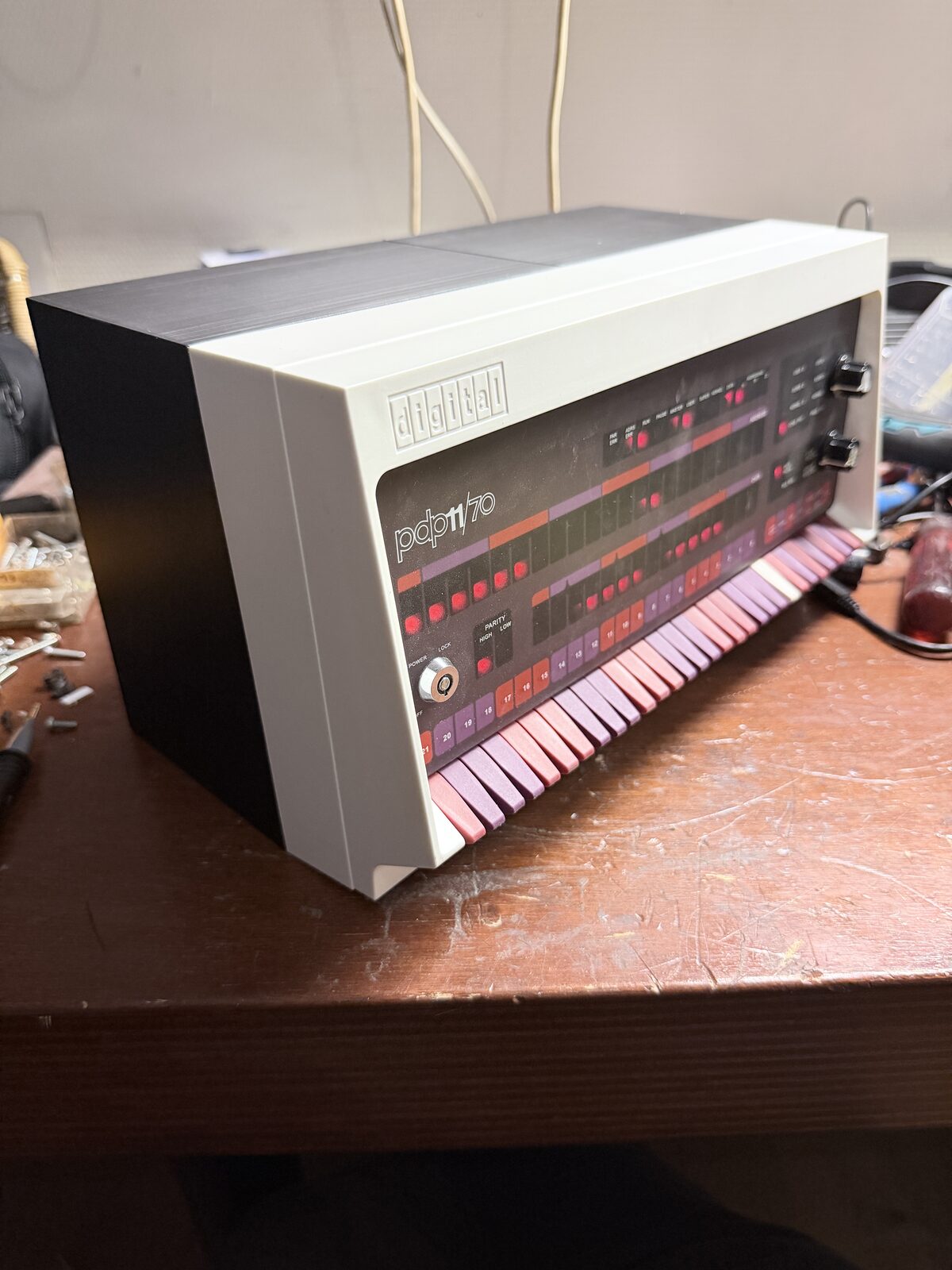
The PiDP-11/70 comes in a nice case, but two things bothered me. It stands on a wooden block, and there is hardly any room inside for cables, USB-serial adapters and the rest. So I designed an extension that goes between the case and the original backplate: 10 cm more depth, and no wooden block.
The shape
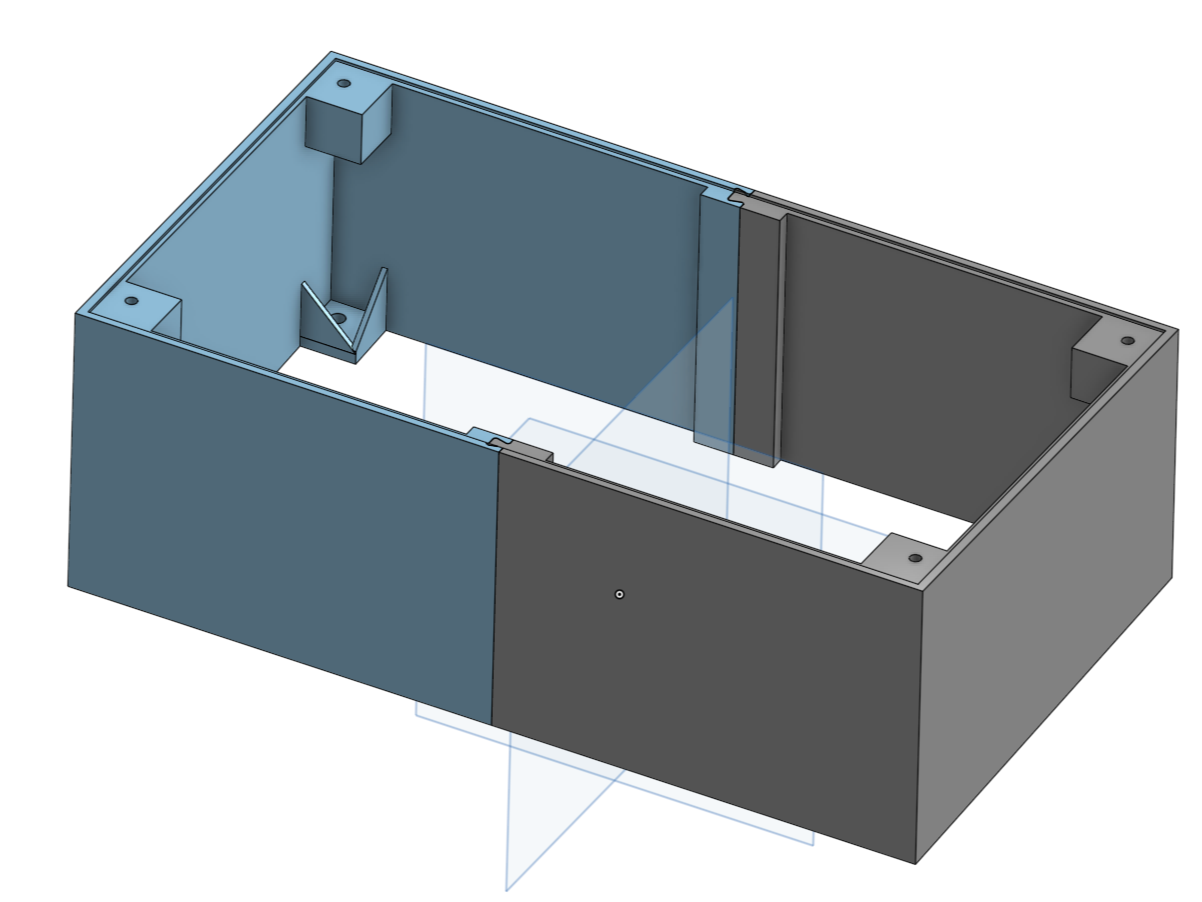
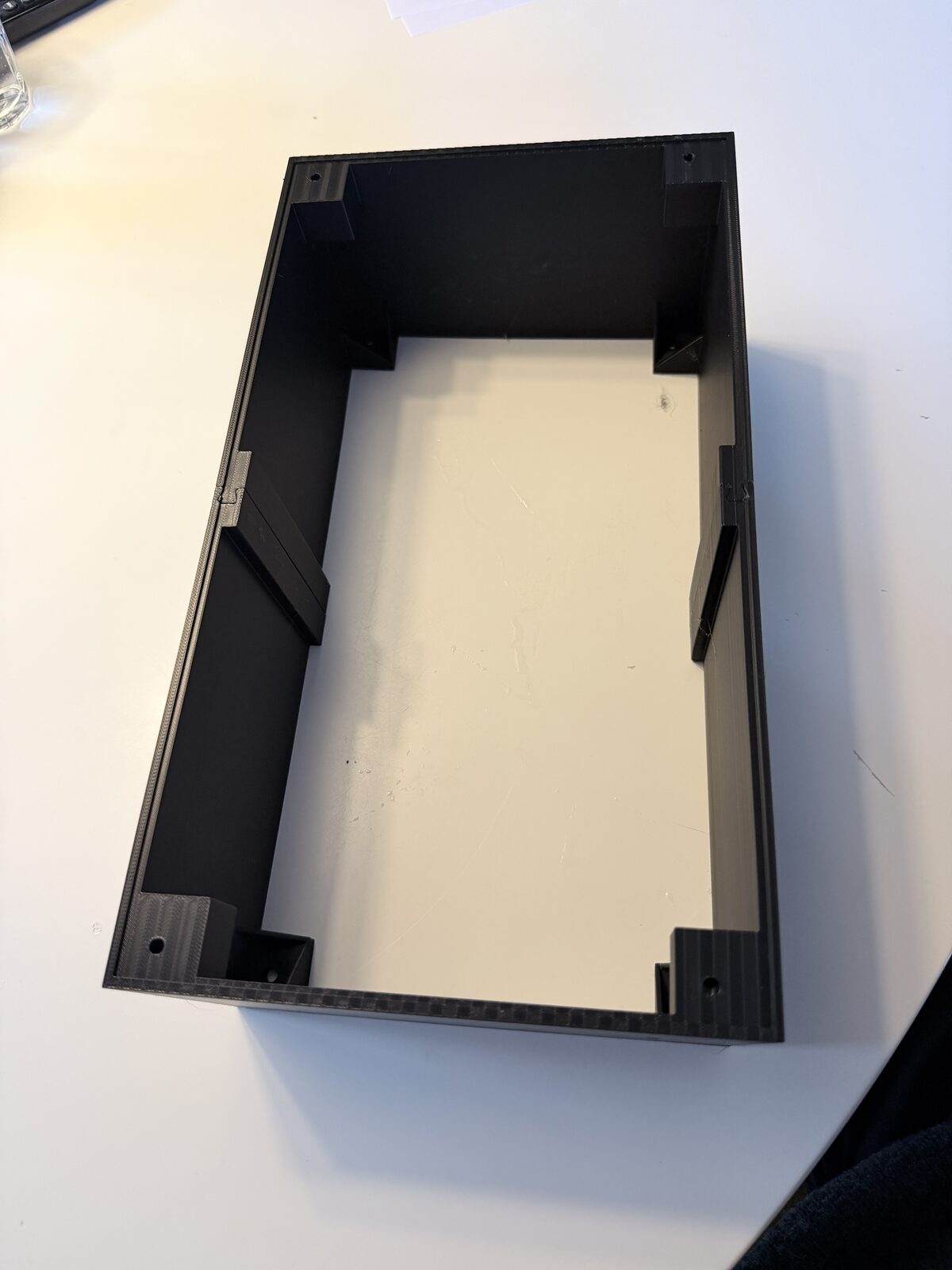
The extension is a frame without top or bottom: 320 × 177 mm on the outside, with 5 mm walls. The PiDP case leans back, so the side that screws onto it is not square to the bottom. The side walls are trapezoids, 110 mm deep at the bottom and 100 mm at the top. The PiDP side follows the slant of the case (3.2°); the back stays vertical. The 177.5 mm height of the case is now measured along the slant, which makes the frame 0.2 mm short there. I left it.
Everything else is about fixing things to it:
- Eight lips in the inner corners, four on each side, 5 mm thick, with holes for M5. The holes in the backplate sit 12 mm from the left and right edges, 13 mm from the top and 17 mm from the bottom, measured from the outside of the frame.
- The backplate, the aluminium one from the PiDP kit, is 313 × 171 mm and 1 mm thick. It drops into a 1 mm rebate in the rear edge, 313.4 × 171.4 mm for 0.2 mm of play, so it ends up flush with the frame.
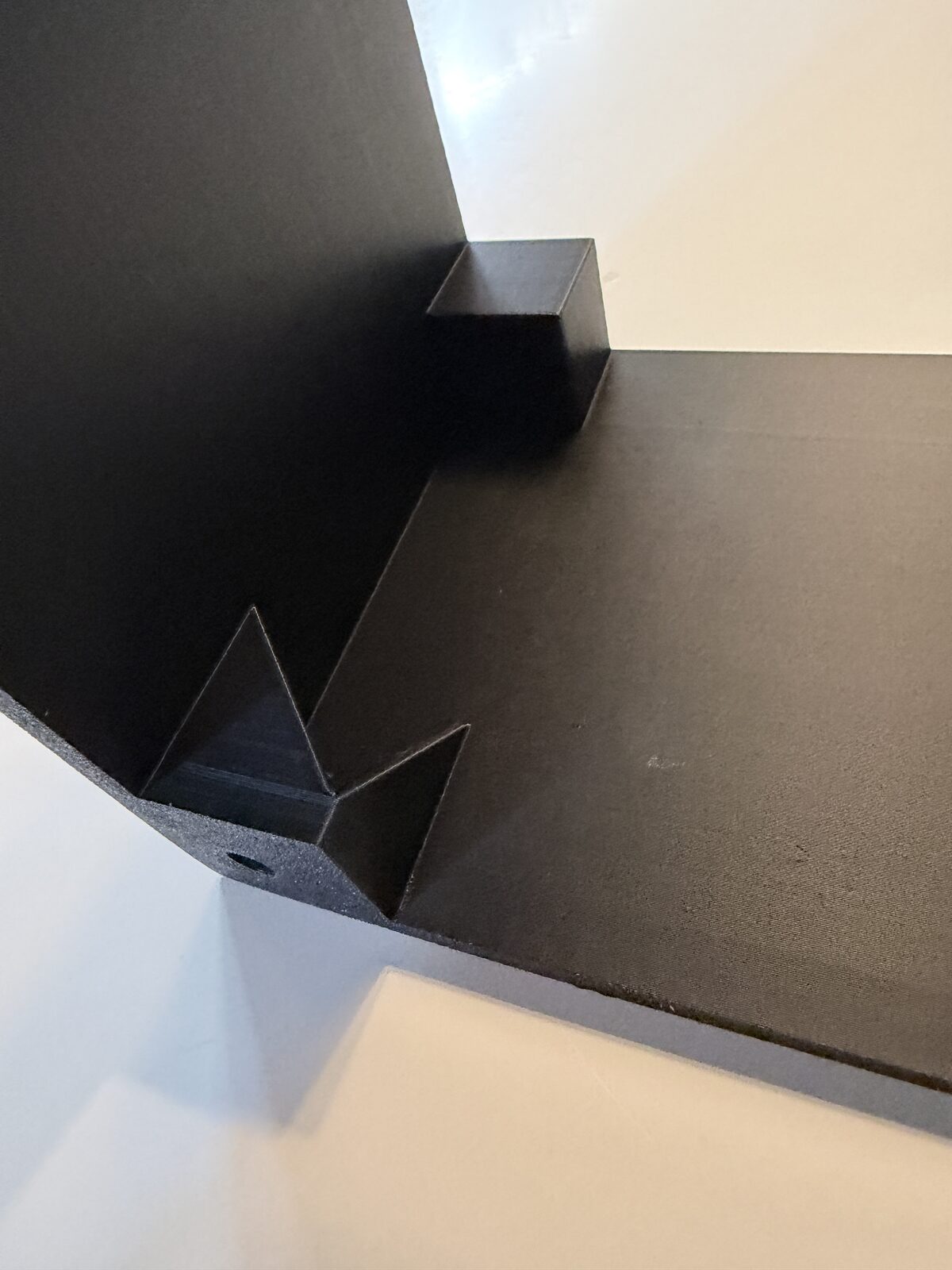
- The backplate is held by heavy M5 sheet-metal screws. Those need something to bite into, so the rear lips became blocks of 20 mm.
- Under each lip on the PiDP side are two thin 45° ribs, so the lip can print without support and there is room for a nut behind the hole.
Two halves
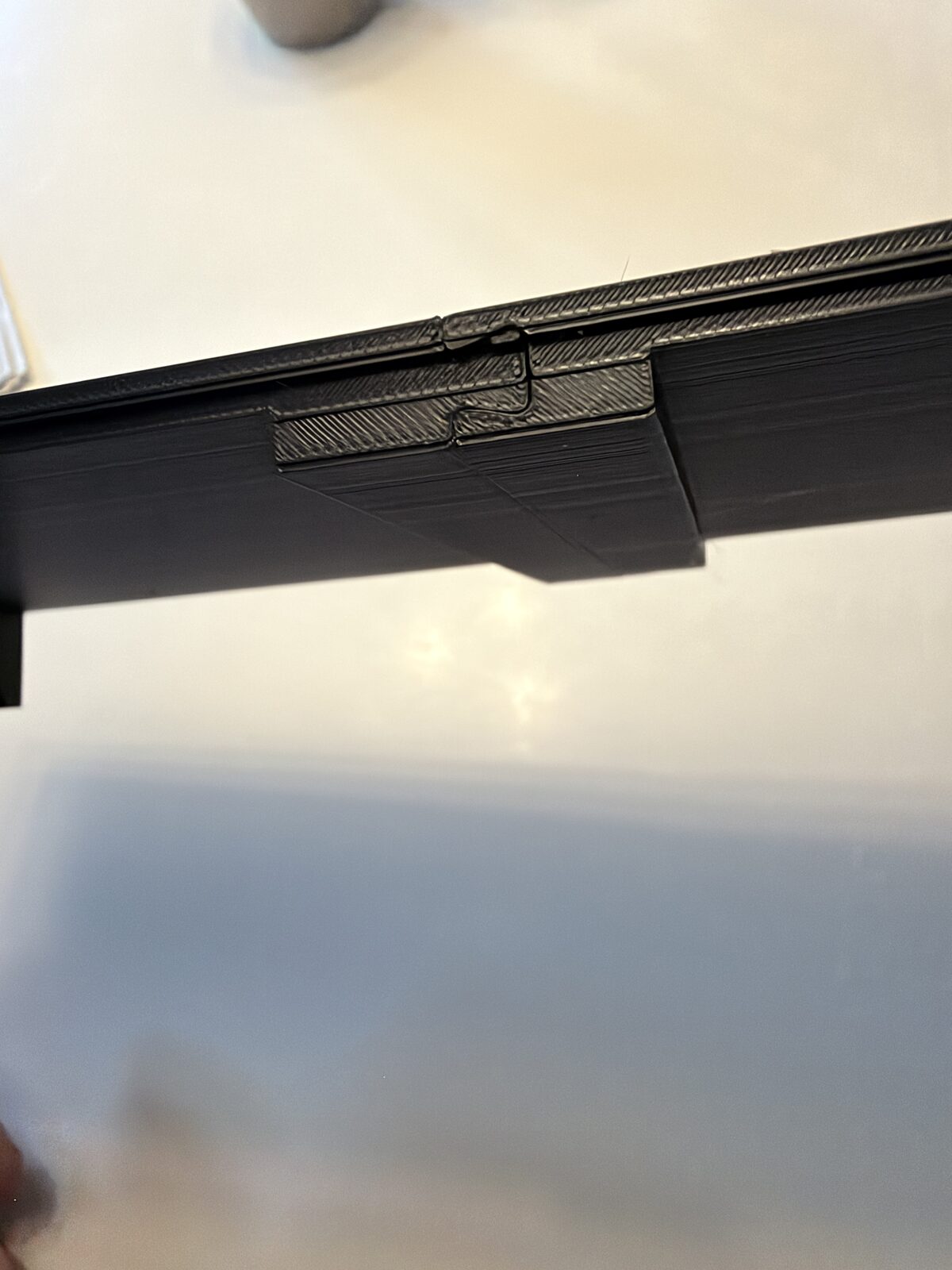
My Bambu A1 has a 256 × 256 mm bed and the frame is 320 mm wide. So it is cut down the middle into two U-shaped halves of 160 mm that join with a dovetail. In Onshape I used the free Dovetail Joint custom feature: split the solid with a plane at 160 mm, then let the feature cut the dovetails along the edges, with clearance for printing built in. The two U's fit next to each other on one plate. Printed, they slide together tight enough that no glue is needed.
I drew the first part in Onshape myself: the rectangle, the 5 mm offset for the walls, the split. Then I let Claude take over my Chrome, and it built the rest by clicking through Onshape: the trapezoid walls, the lips, the rebate and the ribs, while I checked the dimensions. The first time round it made only seven of the eight holes.
Slicing
The halves went out of Onshape as STL and into Bambu Studio. Two things tripped me up there. Bambu Studio took over the part colours from Onshape, blue and grey, as two filaments, complete with a prime tower. And it laid the slanted PiDP side flat on the bed, so the whole frame leaned over by 3.2°, and after turning one half 180° it looked mirrored. It took a while before Claude and I agreed on what we were looking at.
In the end I printed it in exactly that orientation, with the PiDP side on the bed. That is the face that has to sit tight against the case, and it comes out perfectly flat. The 20 mm blocks at the back then hang in the air, about 85 mm up, so they get support pillars.
On the PiDP
The extension screws straight onto the PiDP, and the original backplate screws onto the extension. Inside there is now room for the bundle of cable from the USB-serial converters, and the charger that powers the Pi is going in there too.
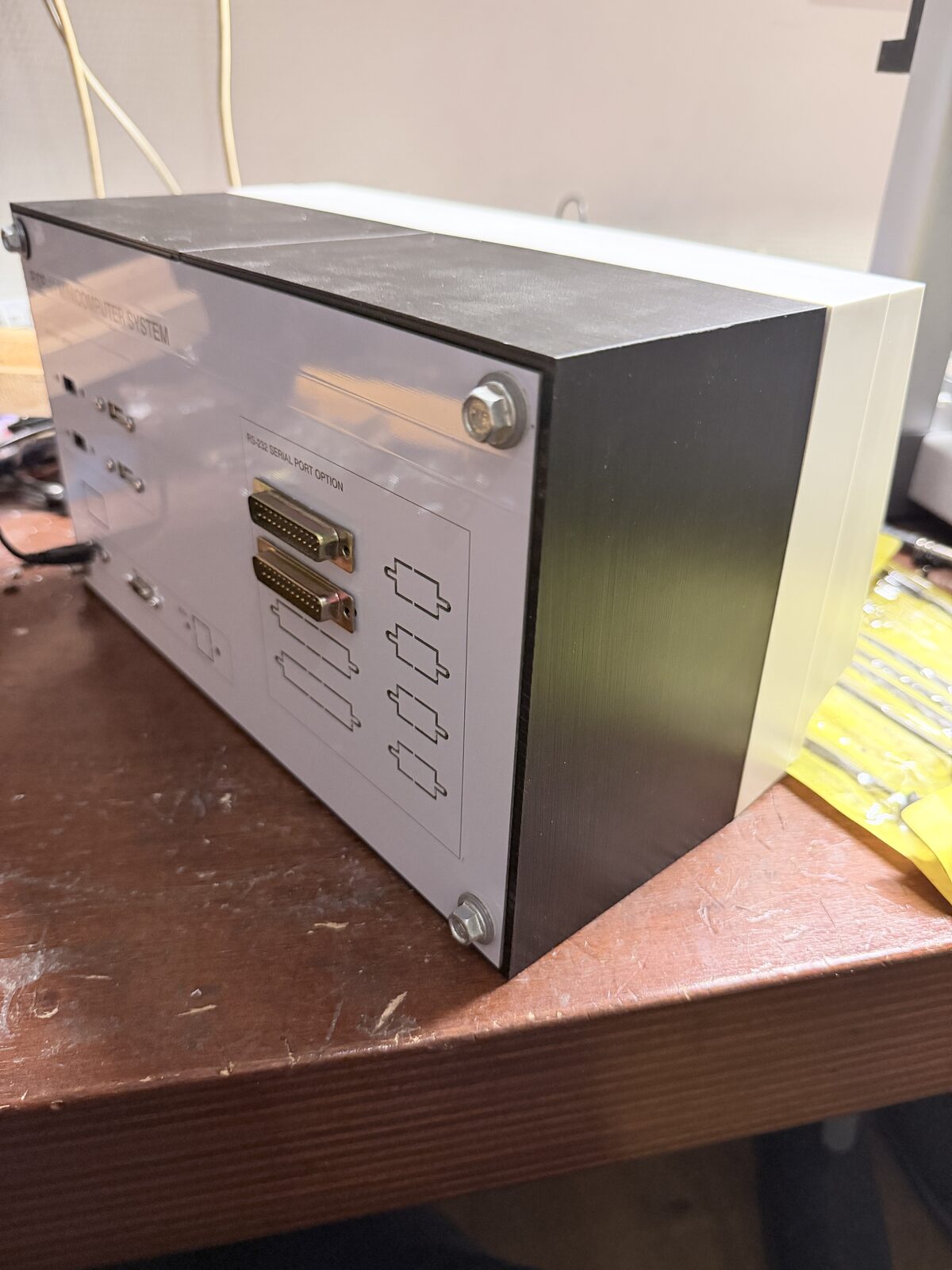
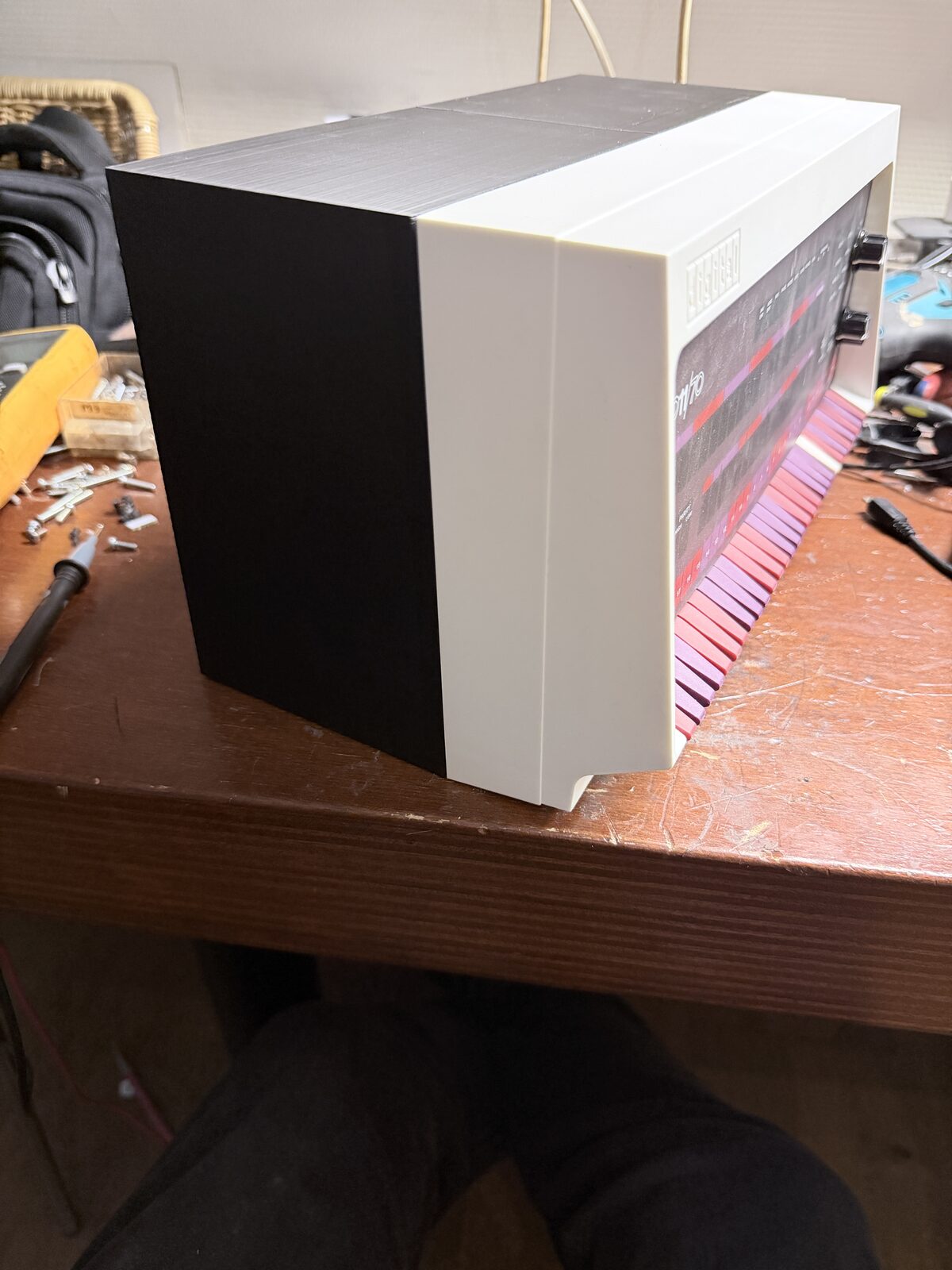
The model is on MakerWorld, under CC BY-SA. The print profile there is PLA, 0.2 mm layers, 2 walls and 15% infill: one plate, 340 g and about 10.8 hours.