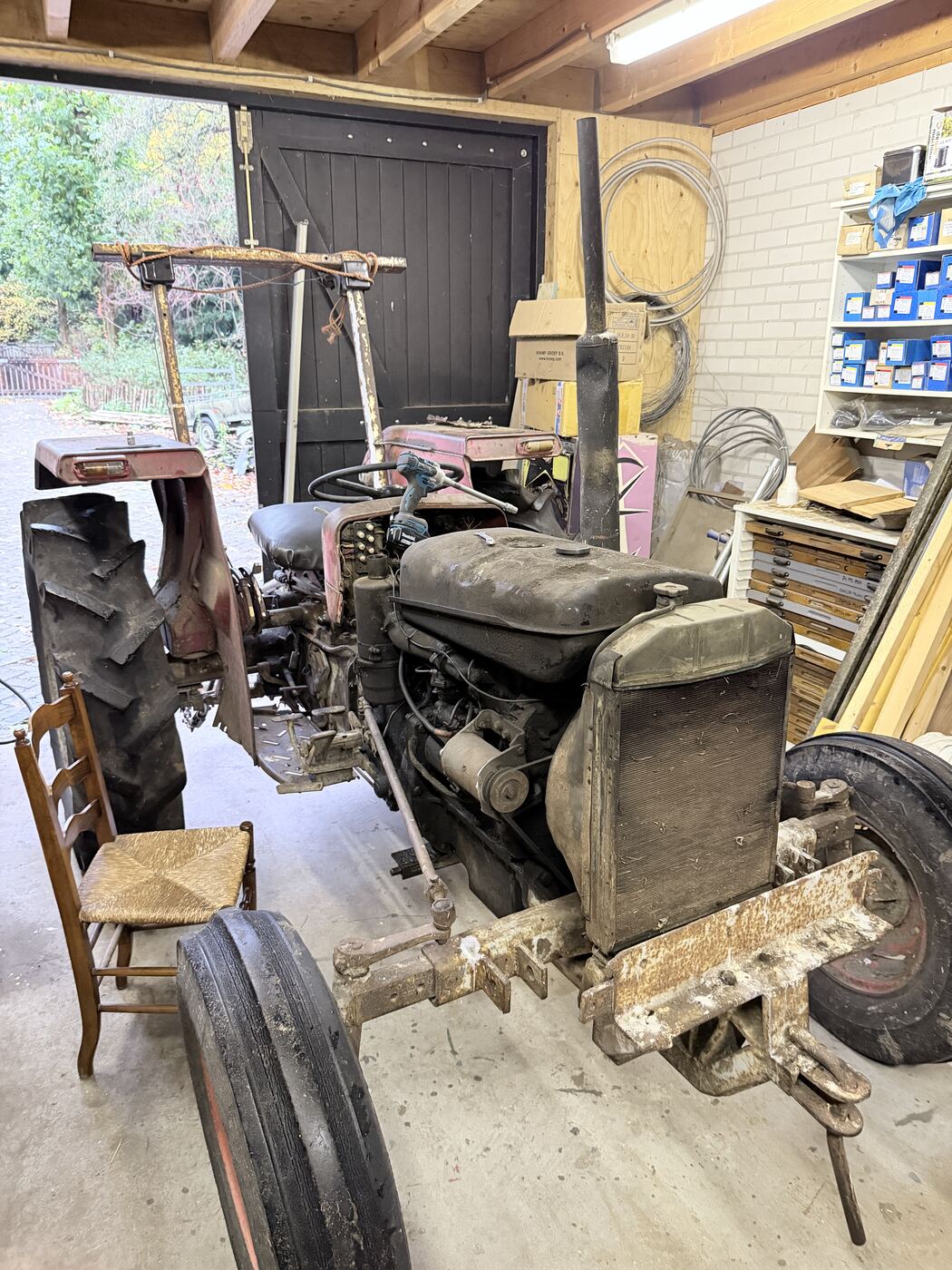
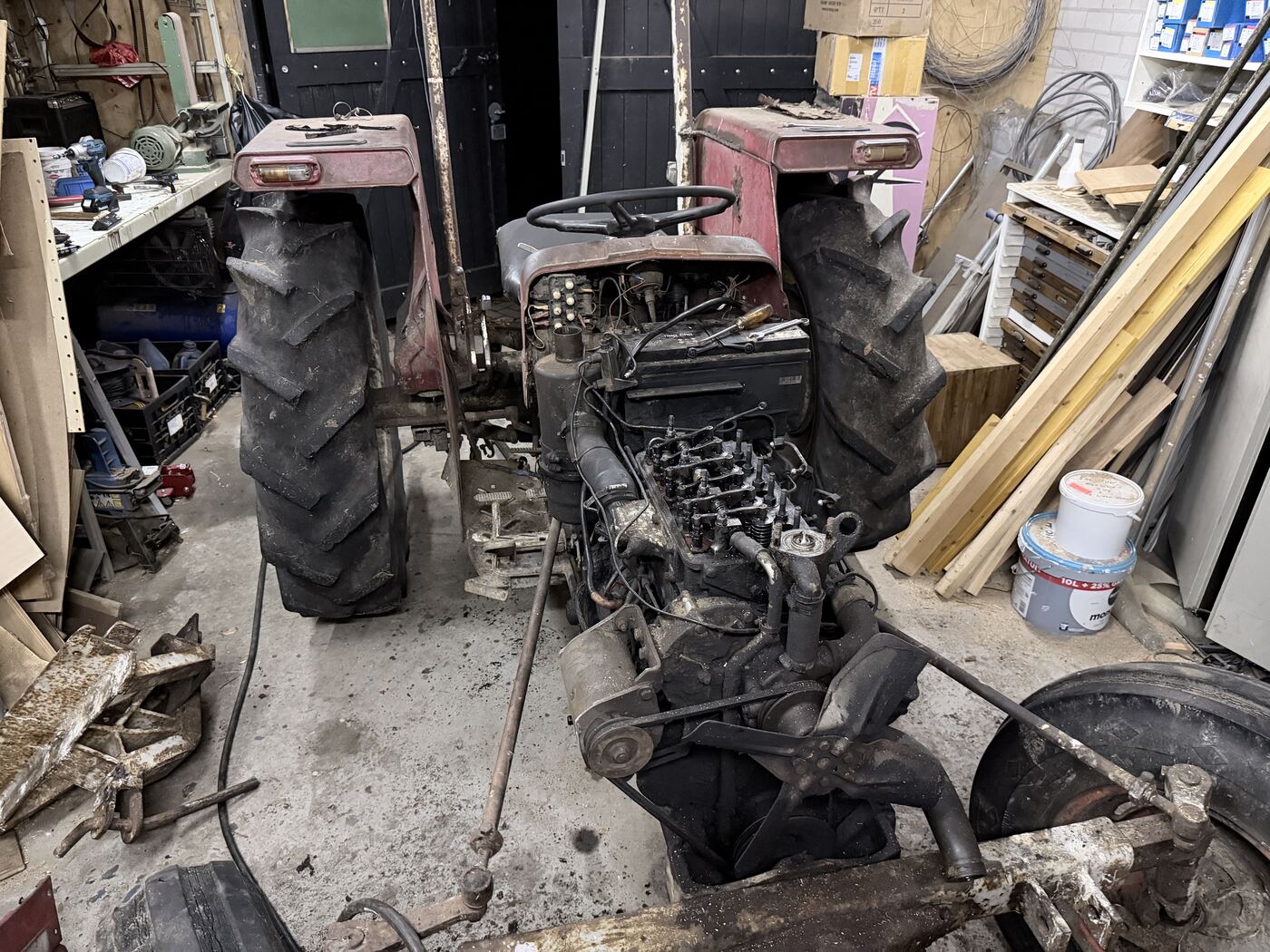
In November 2025 my Massey Ferguson 133 started running badly. It had little power, idled roughly and felt like it was running on two of its three cylinders. There was no black or white smoke at no load, but when I switched it off, the exhaust made a strange sucking, blowing noise. This is how I found out what was wrong.
Which engine is it?
Before you can order a single part for an old tractor, you need to know what is in it. The MF133 has a three-cylinder Perkins diesel, but which one? When I first read up on compression tests, in June 2025, I called it an A3.152. Tractordata lists the 1969–1974 MF133 with an AD3.144. On forums people say the early French-built 133s had the A3.144. And the parts shops sell almost everything "for A3.144/A3.152", which doesn't narrow it down.
On the engine itself I found:
GKN1308andJ12-1cast into the cylinder head;- covers over the injection chambers, and straight injectors;
- inlet and exhaust manifolds on opposite sides of the head;
- the head held down by 15 nuts on studs (more about those below).
The Perkins AD engines have direct injection. Mine injects into a chamber in the head, so it can't be an AD, which rules out tractordata's AD3.144. That leaves the A3.144 or the A3.152. What settled it is that mine is a French-built MF133, and those had the A3.144: three cylinders, 144 cubic inches.
Valves first
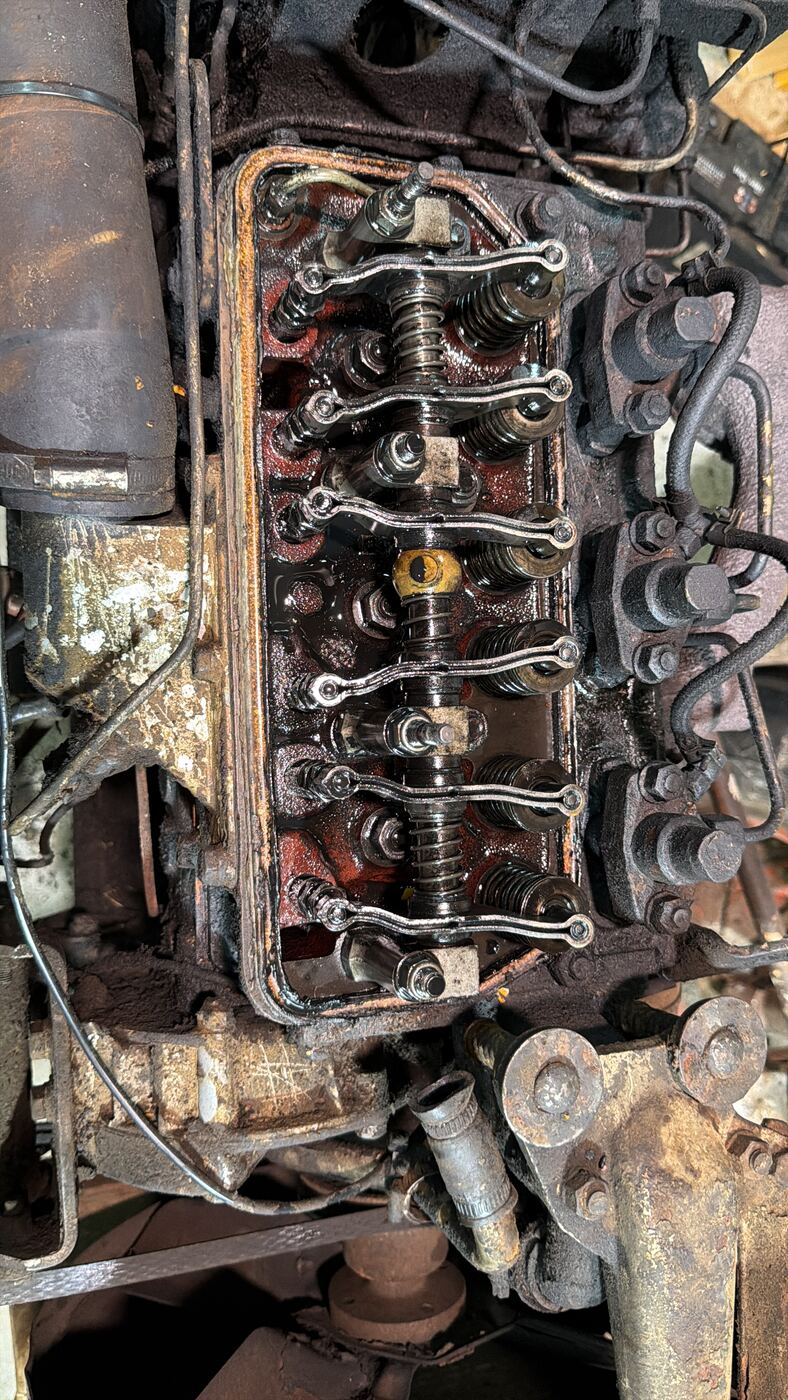
The first suspect was the valve gear. With the rocker cover off I checked the clearances: 0.30 mm on all six valves, cold. I hadn't adjusted anything. Turning the engine over by hand, all rockers, pushrods and valves moved as they should.
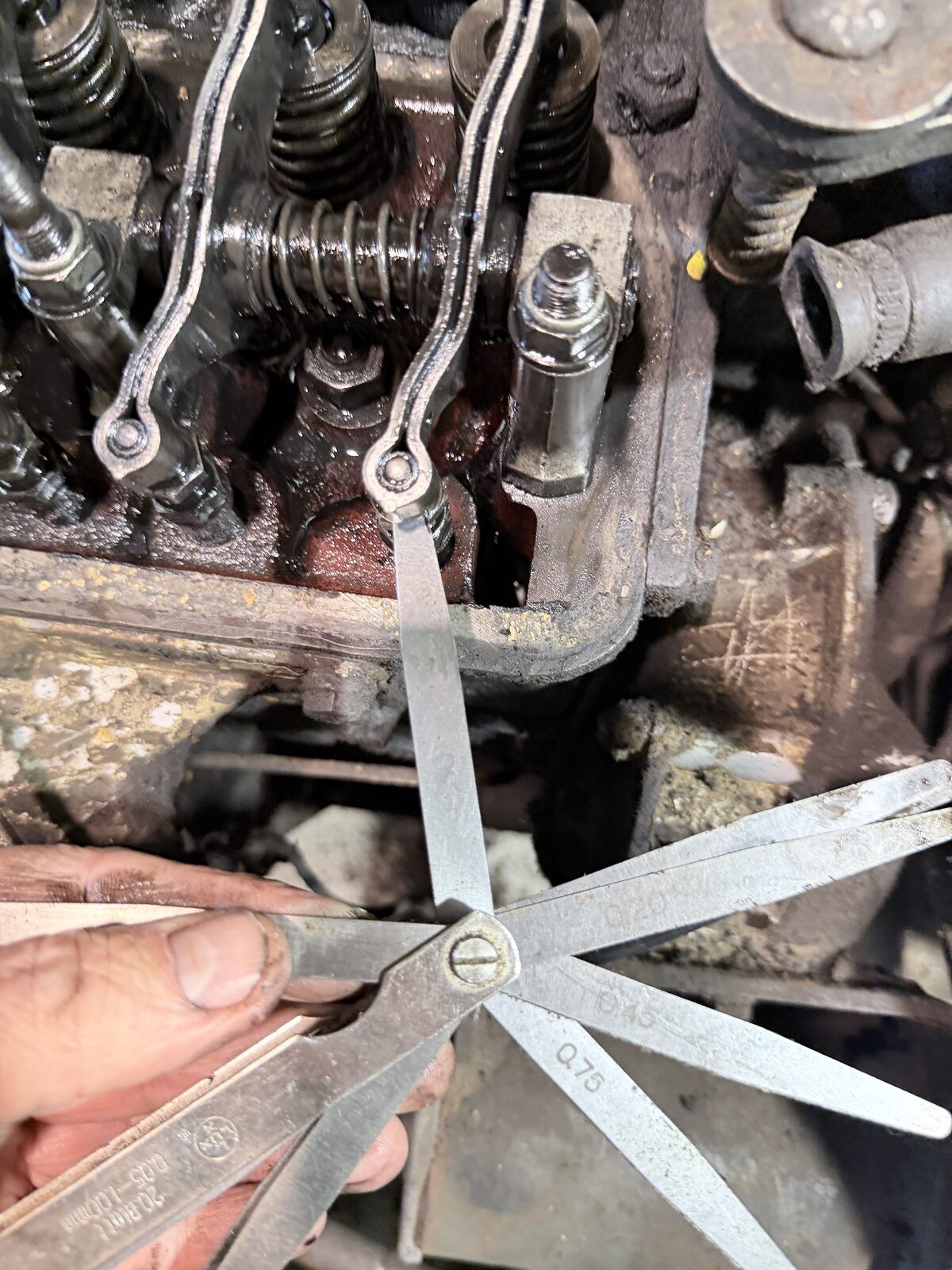
That doesn't clear the valves, though. A valve that is burnt, or doesn't seat, still shows a perfect clearance at the rocker; it just doesn't seal at the bottom. And the noise at shut-down pointed that way. Once the engine stops, the injection pump stops too, so a blowing noise in the exhaust can't come from an injector. It has to be air, getting past a valve that doesn't close.
Compression test
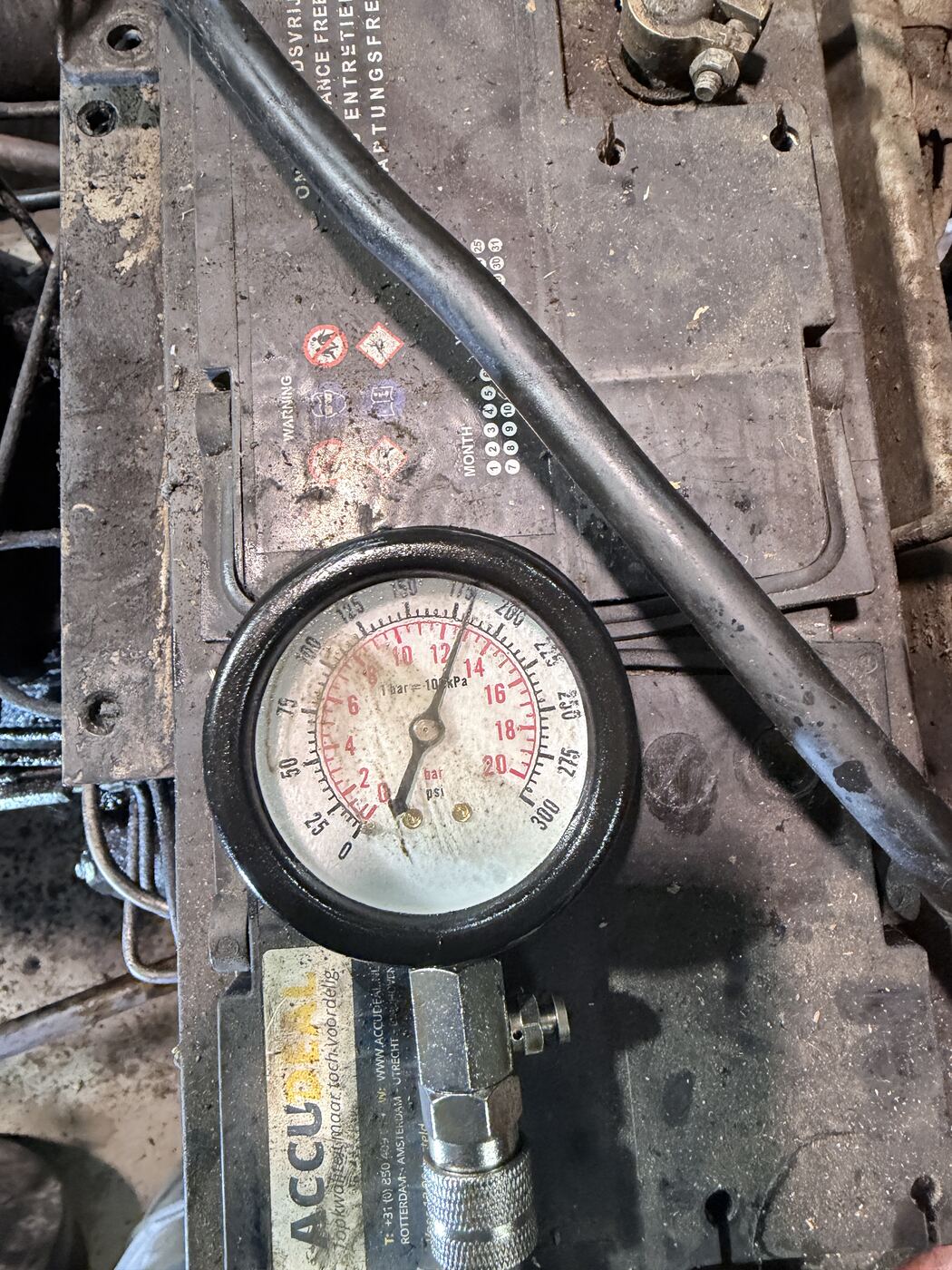
The gauge screws into the injector hole: injectors out, gauge in, crank on the starter. Counting the cylinders from the radiator:
| Cylinder | Compression |
|---|---|
| 1 | 176 psi |
| 2 | 150 psi |
| 3 | 178 psi |
Cylinder 2 was clearly down. Then I fed compressed air into the cylinders through the injector holes. On cylinders 1 and 2 I heard it hiss in the exhaust. For me that settled it: an exhaust valve that didn't seal, probably a burnt one.
A new head, or the old one?
With a bad valve the head had to come off anyway, so I looked at replacement heads. Several shops sell a complete head with valves for the A3.144 and A3.152 under the number ZZ80048. They are aftermarket parts, and I couldn't find out who makes them or how they are checked. The alternative was reconditioning my own head: new guides, new valves, lapping them in. Either way, the head had to come off first, so I could see what I was dealing with.
Testing the injectors
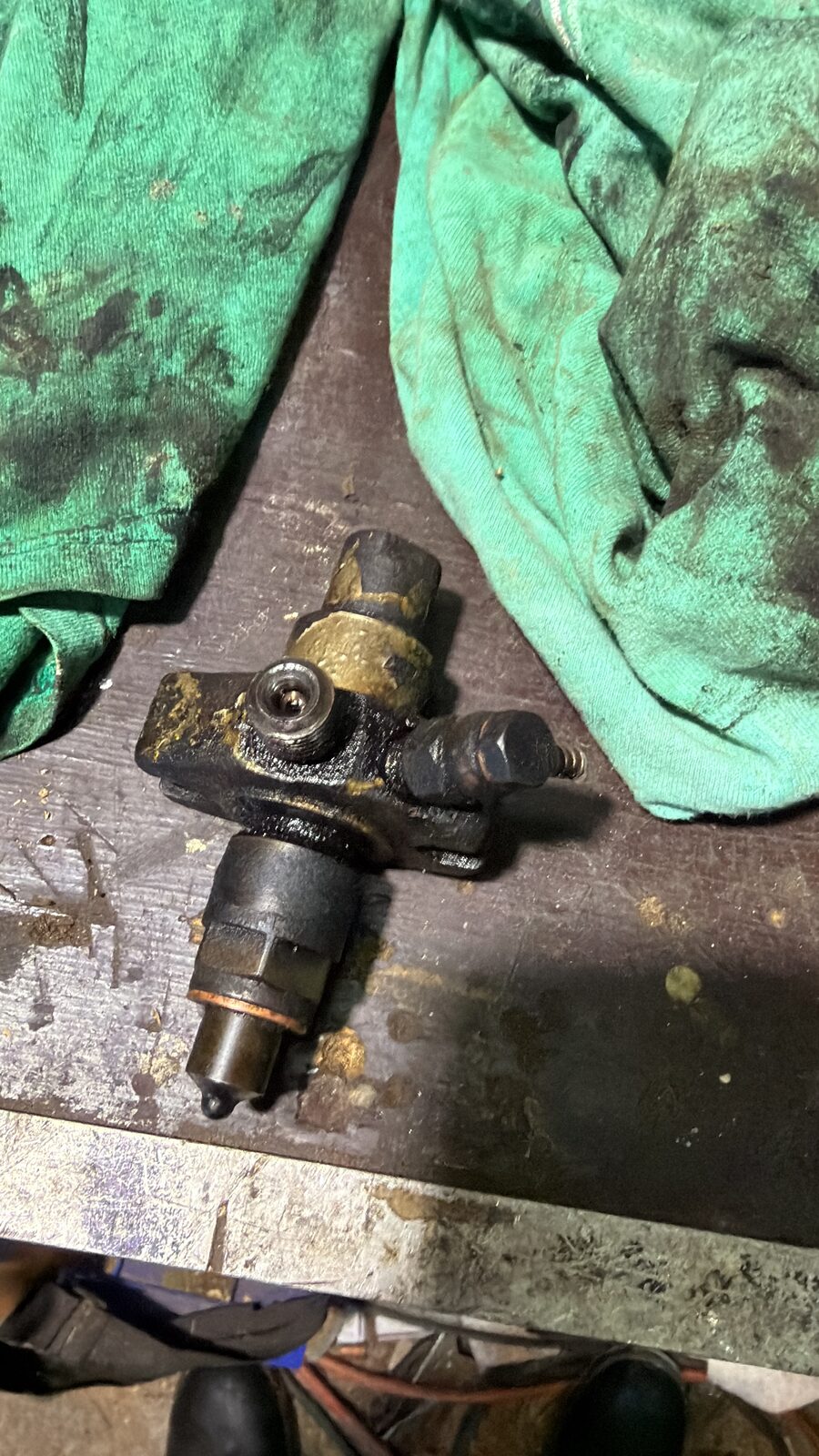
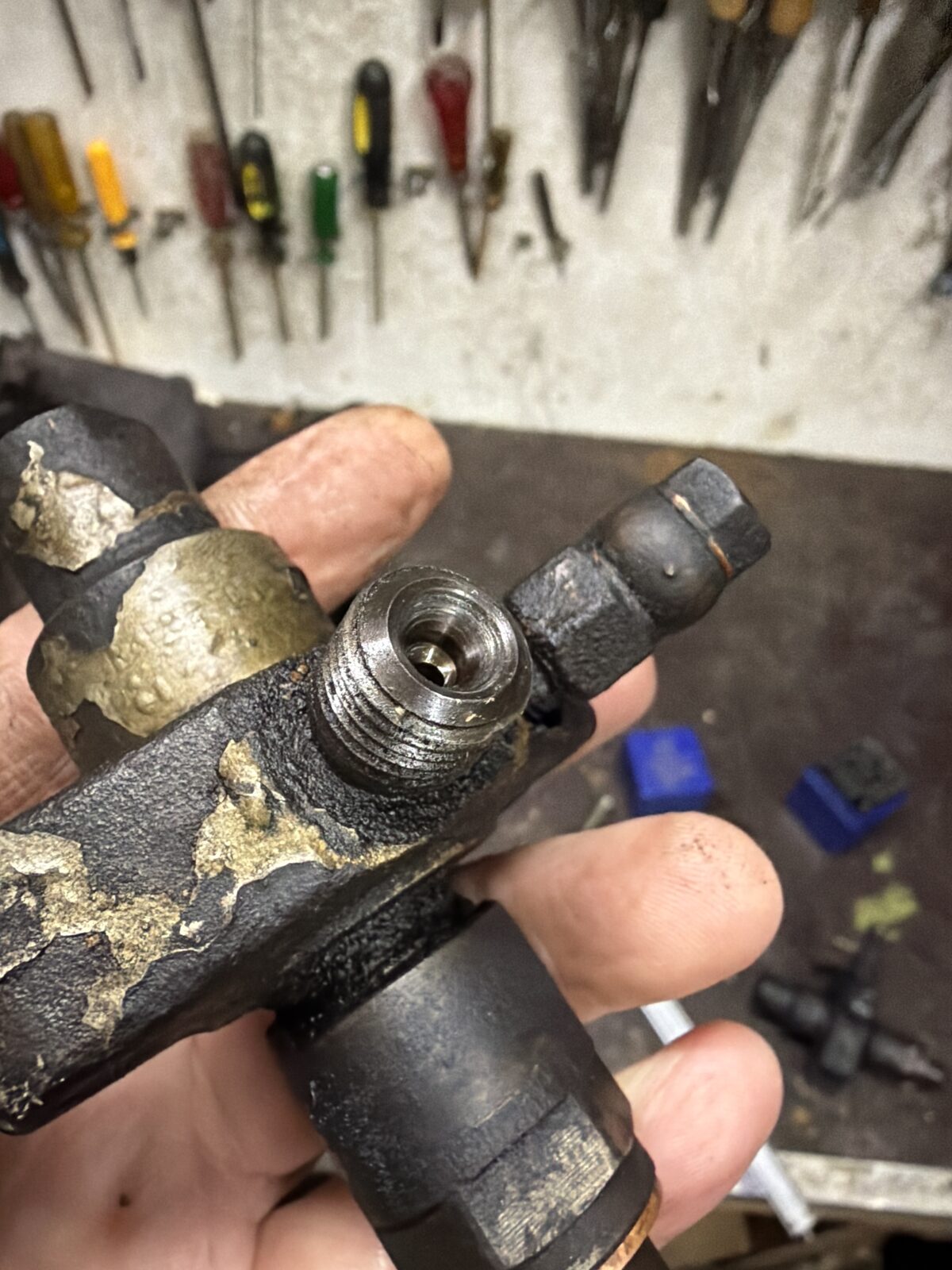
With the injectors out, I wanted to test them too. I bought a VEVOR pop tester, a hand pump with a gauge. Its outlets are M14×1.5. The fuel inlet on these injectors is supposed to be a male 9/16"-18 UNF thread, so I expected to need an adapter. ChatGPT agreed, then looked at a photo and declared it "100% M14×1.5", then went back to UNF.
The two threads are close:
| M14×1.5 | 9/16"-18 UNF | |
|---|---|---|
| Outside diameter | 14.00 mm | 14.29 mm |
| Pitch | 1.50 mm | 1.41 mm |
I measured 14 mm across the thread, and an M14×1.5 nut screwed on perfectly. On a real 9/16"-18 thread it shouldn't: the pitches differ by 0.09 mm per turn. So either this tractor, where everything else is in inches, has metric injector inlets, or a metric nut runs on a UNF thread after all. I still don't know which.
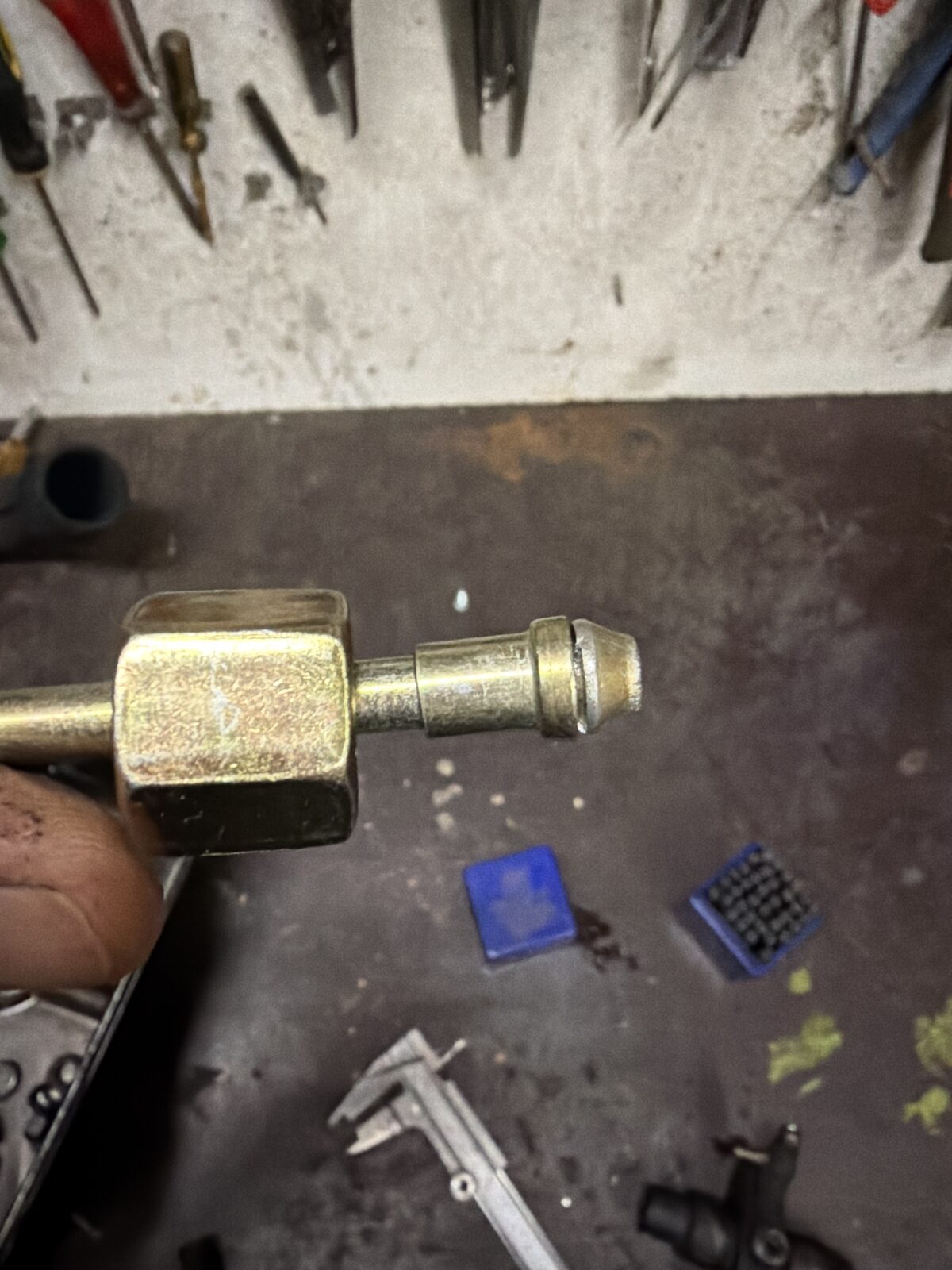
On these injector pipes the thread doesn't seal anything. The pipe ends in a cone that presses into a cone seat in the injector; the nut only pulls it in. So the test line was just a short pipe with a cone and an M14×1.5 nut, and it simply fitted. If the inlet is UNF, that is a garage trick and purists should look away; either way, no adapter needed.
It worked: the joint stayed dry. The injectors opened at around 2000 psi (about 140 bar), nothing leaked, and the pressure just stayed up. All three were fine.
The head comes off
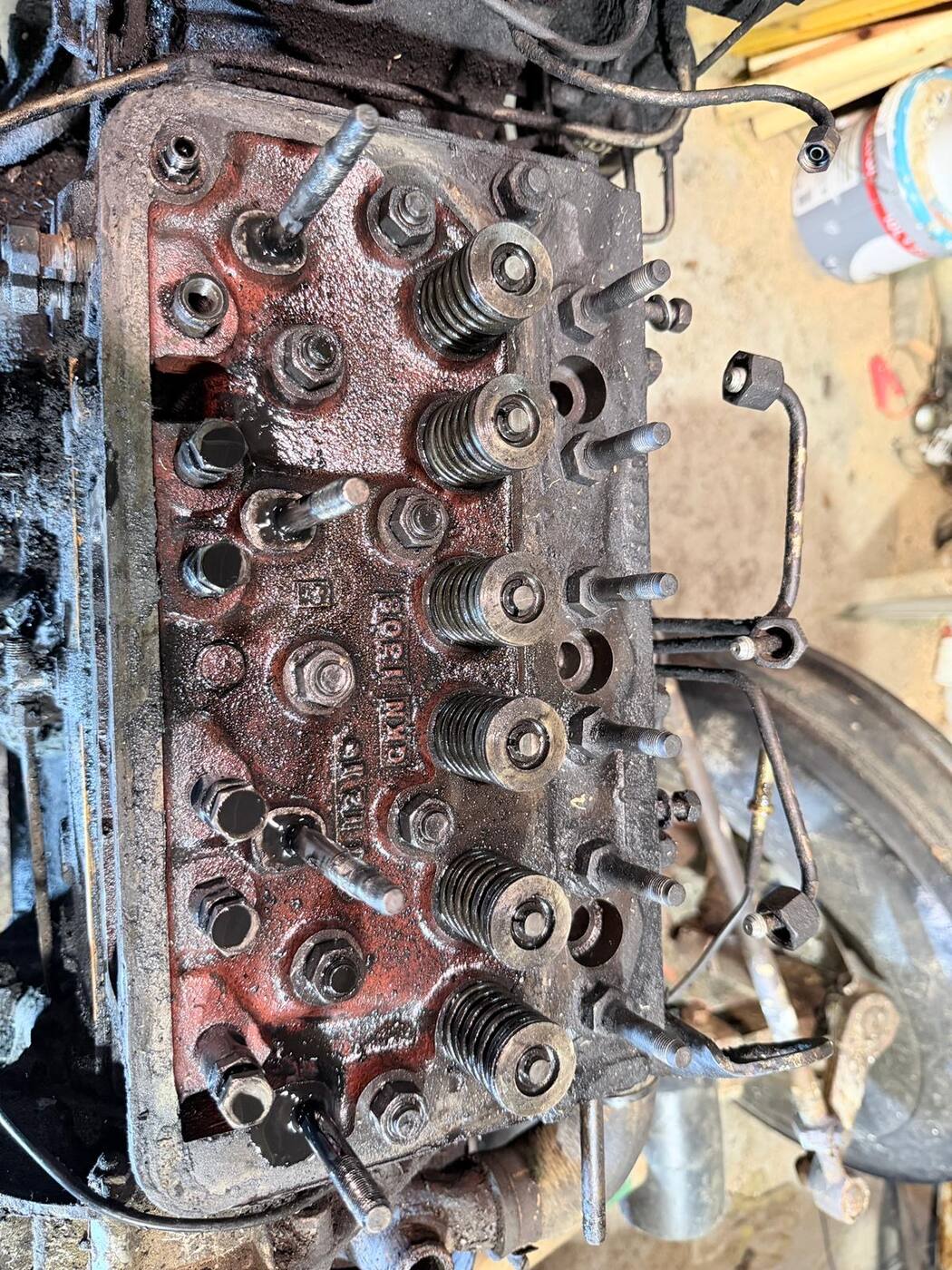
When the head finally came off, it wasn't the valves. The head gasket had burnt through between cylinders 1 and 2, the front one and the middle one: the same two that had hissed in the air test. That explains the hiss as well. Air pushed into one of them escaped through the gasket into the other, and out through its exhaust valve if that happened to be open. The valves were fine.
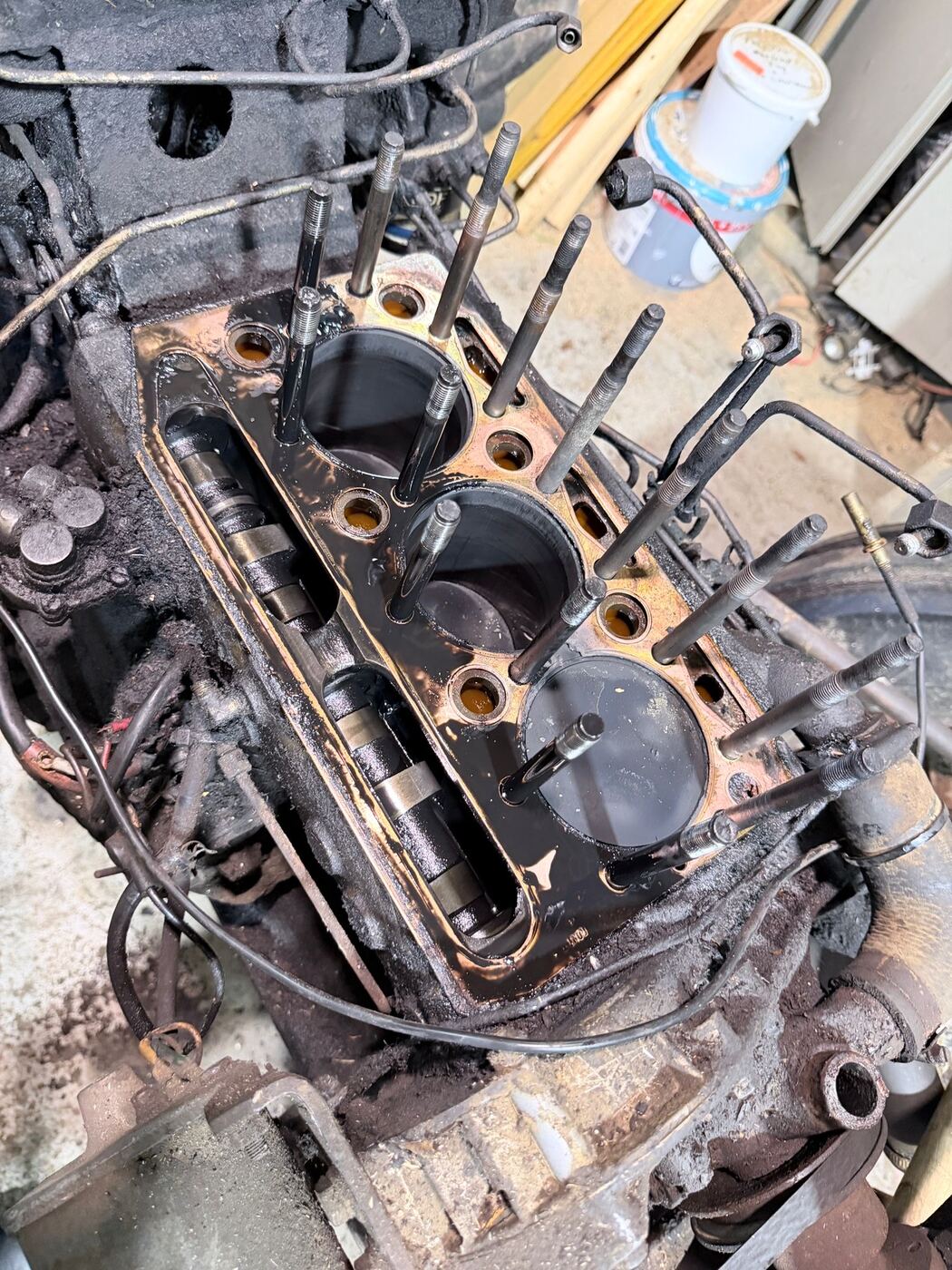
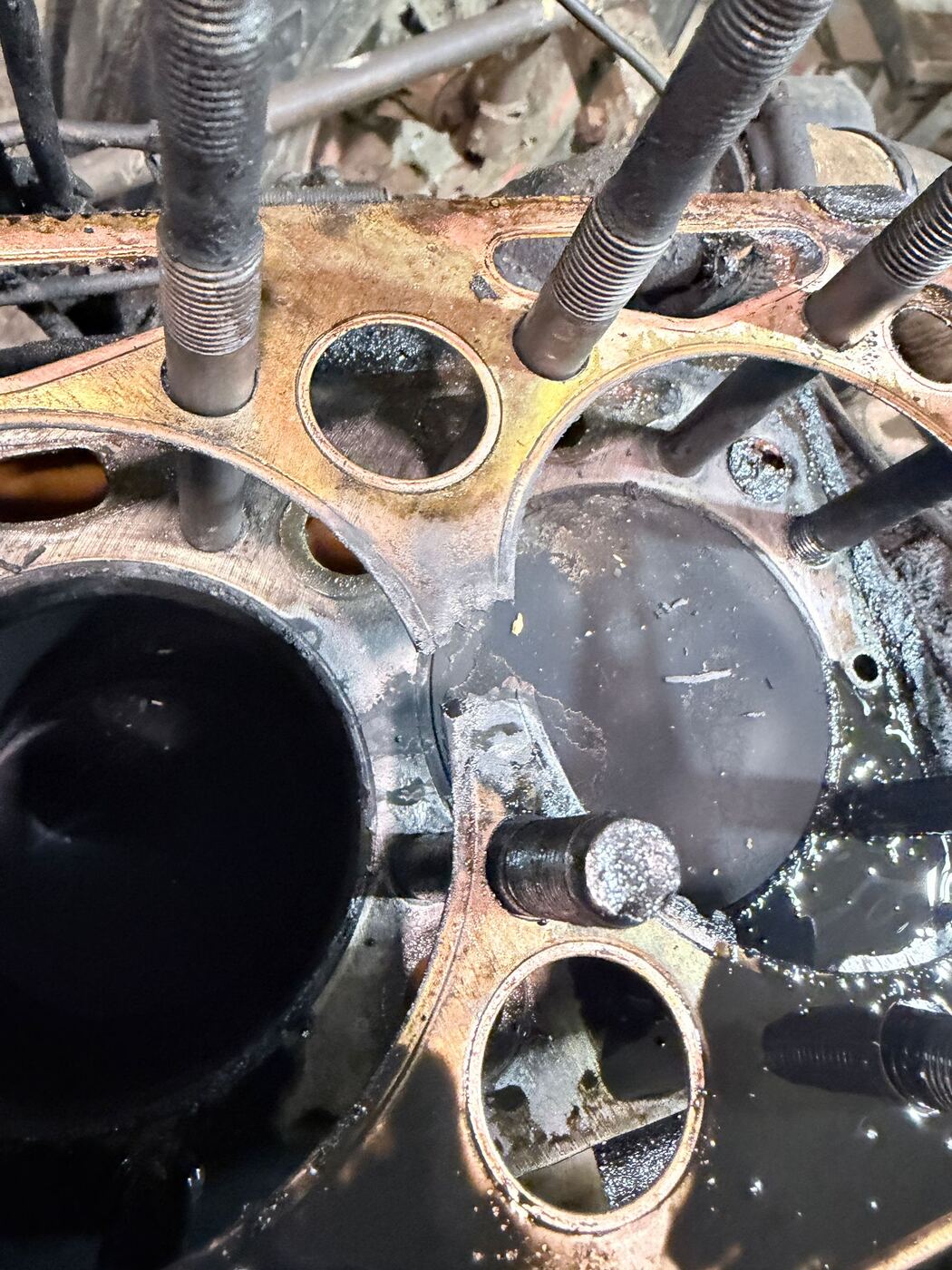
The most likely cause is a broken thermostat, or the engine having run short of oil at some point.
Does the head need skimming?
The usual advice is to skim the head whenever it is off. I cleaned the head and the block with a razor blade, corrosion included. The corrosion was only around the water passages, and between the cylinders there was no pitting: both surfaces were smooth. ChatGPT's advice: with surfaces like that and a copper head gasket, which tolerates small imperfections, it could go back on without skimming. So it did.
Nuts and studs
The head is held down by 15 nuts on studs. ChatGPT spoke of head bolts and first told me 18 (three rows of six), then 11, "like most A3.144s". Only when I showed it a drawing with 15 did it agree; I counted, and mine has 15. For the torque I read 74.8–81.6 Nm (55–60 lbf·ft); ChatGPT gave 95 Nm for this head. As far as I remember, I went with the 95 Nm.
The other fasteners are a mix too. The exhaust manifold nuts take a 1/2" spanner, and the studs measure 7.9 mm: 5/16". The prechamber cap nuts take 9/16". Yet the Perkins part number for the manifold stud, 37781251, is a 3/8" UNF × 1 5/8" stud, and one supplier sells a single 3/8" UNF stud for both the exhaust and the prechambers. On an engine this old you measure before you order.
Back together
New gasket set, new coolant hoses and a new thermostat. The leak-off pipe was leaking too: the line from the injectors' leak-off back to the filter, with branches to the tank and to the heater plug. I replaced the T-piece in the middle with a compression T.
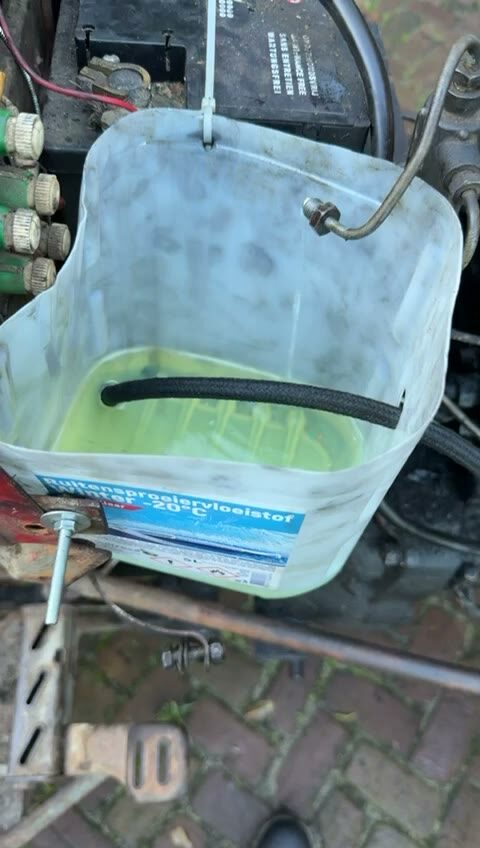
With the tank on the tractor I couldn't see the engine, so for the first runs it got a small improvised tank, mounted above the lift pump, with the return line running back into it.
After the first heat cycle the head nuts get re-torqued. I ran the engine up to temperature with the rocker cover off, let it cool down completely, and then went over the nuts in sequence, tightening each back to torque without slackening it first. ChatGPT first told me to loosen every nut and re-torque it, and changed its mind when I asked whether it was sure.
It runs like a train again, as we say in Dutch.
A note on ChatGPT
I worked through all of this in chats with ChatGPT. That was useful for procedures and for thinking out loud. But it gave numbers with great confidence that changed as soon as I pushed back: 18, 11 and then 15 head bolts; the injector thread was UNF, then "100% M14×1.5" after a photo, then UNF again (I still don't know which one was right). The 15 I got by counting the nuts myself.